 Tidepost
The rules in one minute
The game starts with a grid of dots. Players take turns drawing a single line between two neighbouring dots. Draw the fourth side of a box and that box is yours, and you draw again. When every line is drawn, the player with more boxes wins.
In Tidepost the dots are wooden posts, the lines are ropes and a closed box becomes a striped umbrella in your colour. Tap near a gap or drag from post to post. Boards run from 3×3 to 6×6 boxes, plus a 7×7 board on wide screens. A 3×3 board has 16 posts, 9 boxes and 24 ropes to draw.
Two details matter more than they look. Drawing a box's third side hands that box to your opponent. And taking a box you are offered is never compulsory, a fact the double-cross below is built on.
How to play dots and boxes: the opening
Early on nobody can score, so the aim is simple: never draw a third side while another line is available. A line that gives nothing away is a safe line.
Safe lines are not all equal. Campaign level 23 is a 3×3 board with 13 ropes left and nothing scored. Solving it exactly shows that only three lines are safe, and that two of them reach the target of finishing five boxes ahead while the third finishes three boxes behind. The hint on the screenshot marks one of the good ones.
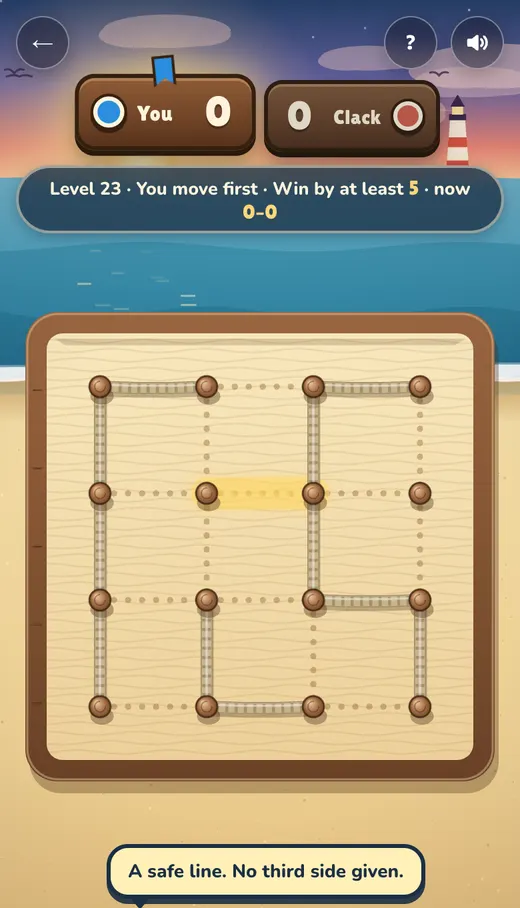
Each safe line uses up a move both players could make for free. When none are left, whoever has to move must give something away, and counting who that will be is the heart of the game.
What happens when the safe lines run out
The board has by now split into chains and loops. A chain is a row of boxes joined end to end, each with two sides drawn, so one rope opens the whole row for your opponent. A loop is a ring of boxes with no end. A chain of one or two boxes is short; three or more is long.
When you must open something, open the shortest chain first. Level 15 shows why. It is a 3×3 board where you lead 2–0 and only two groups remain, a two-box chain and a five-box chain:
+---+---+---+
    | A | A |
+   +---+---+
    |       |
+---+   +   +
        |
+---+---+---+
A marks the two boxes you already own. The two empty boxes in the left column are the two-box chain; the other five form the five-box chain.
The solver rates every rope. Drawing the middle rope of the two-box chain finishes 7–2. Drawing either end of it, or any rope in the five-box chain, finishes 4–5. The middle rope wins because it leaves two separate boxes that cannot be handed back: your opponent takes both and must then open the five-chain for you. An end rope would let them decline and keep control.
The long-chain rule
Whoever must open the first long chain usually loses the game, so the real fight is over parity. The classic rule: count the dots (posts) on the board, then add the number of long chains you expect. The first player wants that total to be even, the second player wants it odd. Loops and chains of one or two boxes are not counted.
A 5×5-box board has 36 dots, so the player who moves first wants an even number of long chains and the player who moves second wants an odd number. A 4×4 board has 25 dots, which flips it. It is a guide, not a guarantee: a loop or a late sacrifice can change the count. Campaign levels 23 to 30 train it.
The double-cross: a worked example
Level 31 starts with two four-box chains on a 3×3 board. Clack has one umbrella, and the first chain has already been opened for you. The target is to win by at least 3.
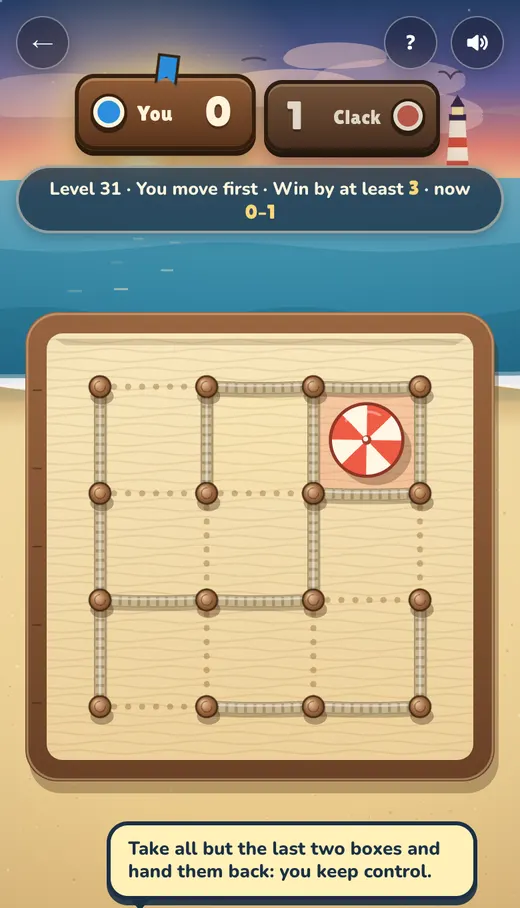
Take the first two boxes, which makes it 2–1. Two boxes remain in that chain. Greedy play takes them as well, reaching 4–1, but then you must open the second chain and Clack takes all four: you lose 4–5.
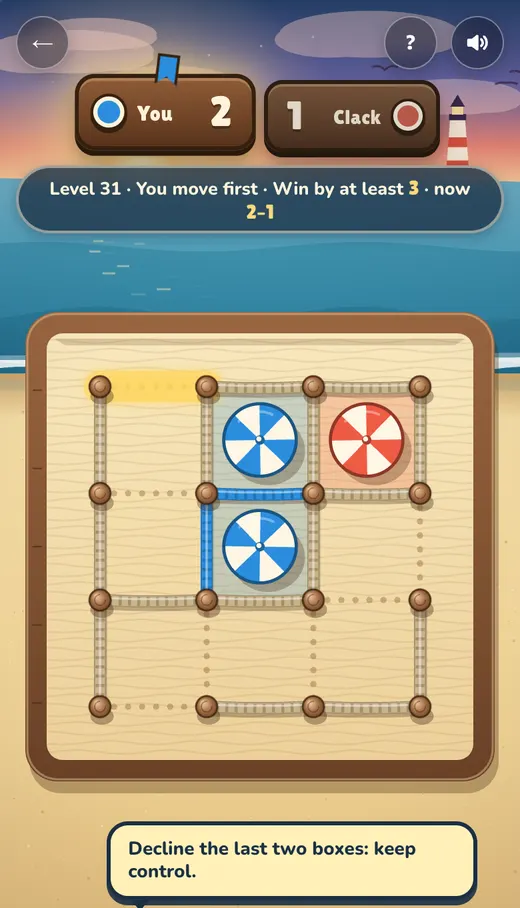
Instead, draw the rope at the far end of those last two boxes. Both boxes are now ready to be taken with one rope, and you have given them away on purpose.
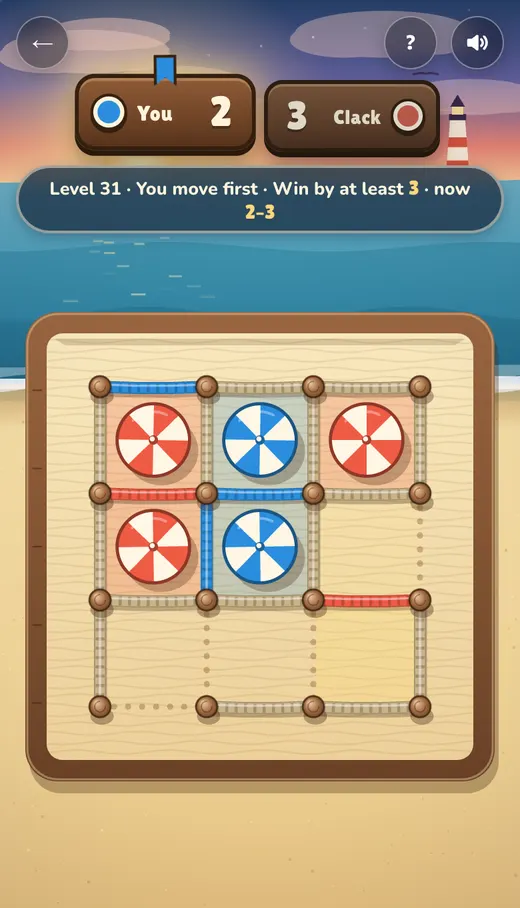
Clack scores two, but has nothing safe left and must open the second chain. You take all four and win 6–3. Strategy writers call your decline the double-dealing move and Clack's two-box capture the double-cross, though most players use one word for the whole idea. It costs you two boxes, so it only pays when the chain left behind is worth more, and never on the last chain of the game.
Loops: open them early
A loop costs more to decline than a chain: four boxes against two. That makes loops the cheapest thing to open first when you are the one giving boxes away.
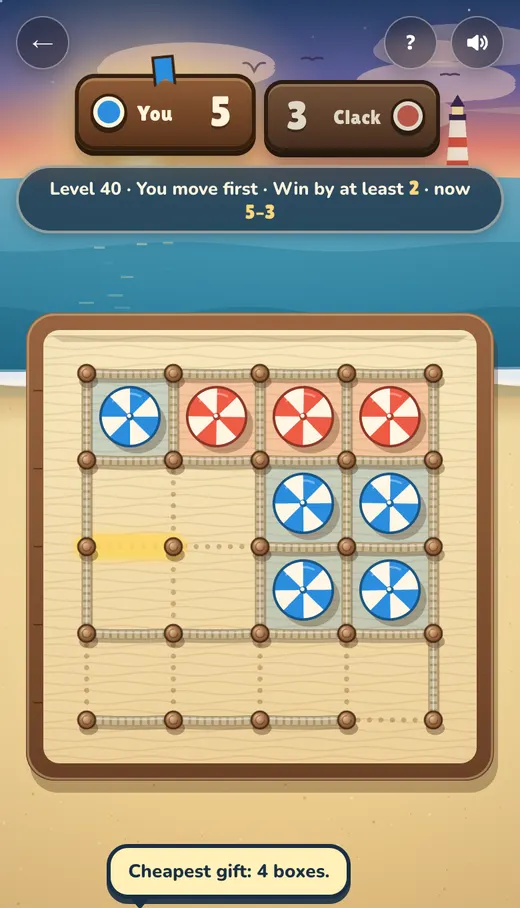
Level 40 is a 4×4 board with a four-box loop and a four-box chain left, you to move at 5–3. Opening the loop first finishes 9–7 and meets the target. Opening the chain first finishes 7–9. The hint reads "Cheapest gift: 4 boxes."
Practise each idea
The 50-level campaign follows this guide in order: free boxes (levels 1–6), the third side (7–14), short before long (15–22), the long-chain rule (23–30), the double-cross (31–38), loops (39–46) and four Harbour master levels (47–50). All are open from the start. The daily puzzle adds three new endgames every day.